The vacancy deserves
two readings.
First understand the contribution. Then read the requirements, location and conditions without filling the missing fields yourself.
Read a healthcare vacancy ↗WORK / LEARNING / THE NORTH TEXAS REGION
A PUBLIC-SOURCE JOURNAL
ISSUE 01
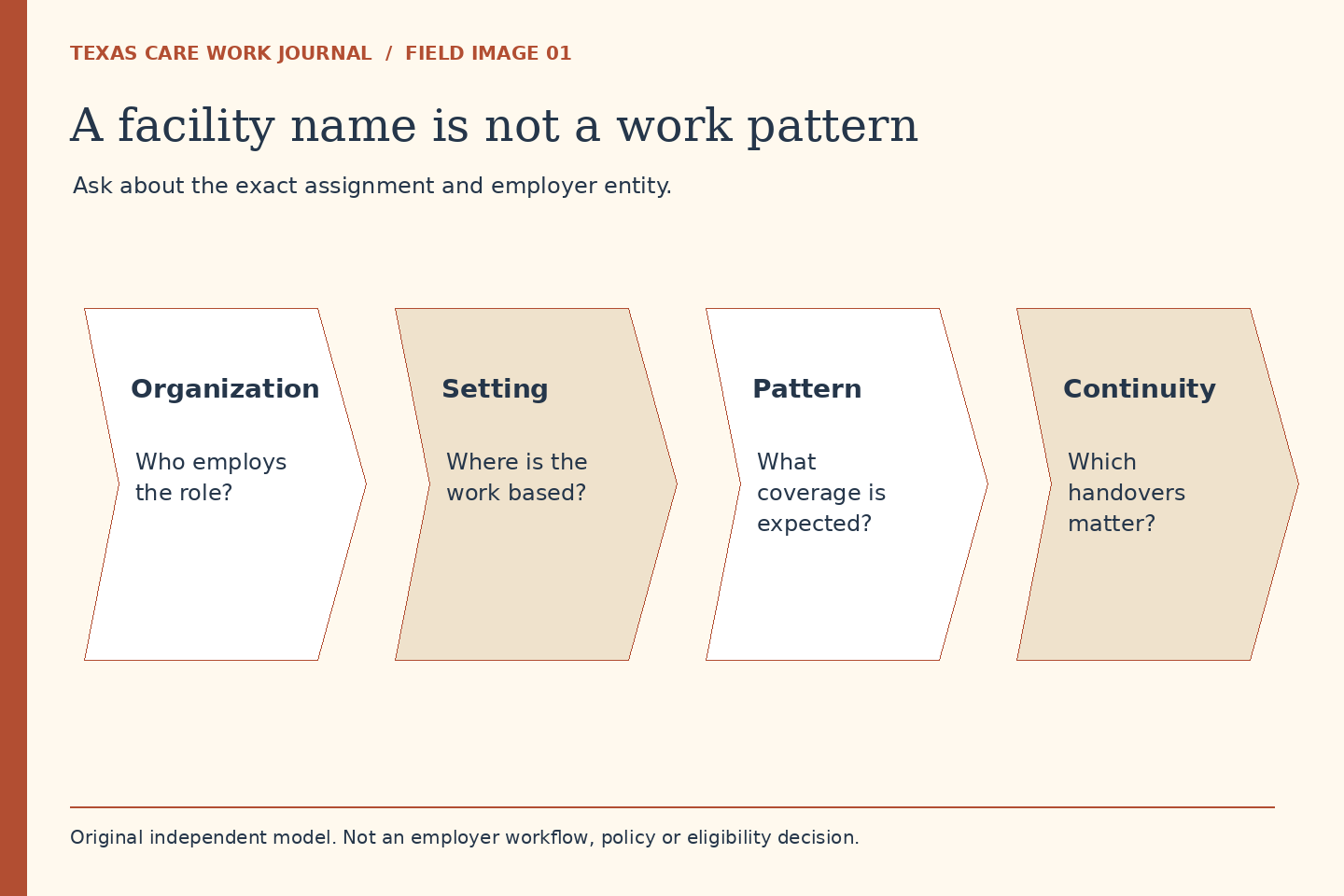
FIELD IMAGE 01 / THE QUESTIONS BEHIND A FACILITY NAME
AN INDEPENDENT NORTH TEXAS WORK JOURNAL
Healthcare careers extend well beyond a single title or building. Explore the settings, support work and learning questions around Texas Health Resources.
Read the opening essay →Independent of Texas Health Resources. No patient care, account access or official employer support.
Setting → Requirements → Evidence → Next question
First understand the contribution. Then read the requirements, location and conditions without filling the missing fields yourself.
Read a healthcare vacancy ↗A strong example shows your judgment and contribution while keeping patient and employer information private.
Build safe career evidence ↗Separate interest, permitted learning and the formal preparation required for a different occupation.
Plan the next research step ↗Role & Setting Lens
Select a work direction and a setting you are researching. The lens adds the question that a broad career page cannot settle. It does not assess qualification or rank employers.
Useful output: A service-work evidence example and a setting-specific question.
Scope limit: No cleaning, infection-control, food-safety or patient-care procedure; use current authorized training.
Useful output: A bounded inventory example with an exact scope question.
Scope limit: No purchasing authority, distribution instructions or access to employer inventory systems.
Useful output: A role-specific qualification comparison and one training question.
Scope limit: No device repair, testing, clinical operation or authorization inferred from this reading tool.
Useful output: A safe demonstration of accuracy and a question about role boundaries.
Scope limit: No patient records, coding decision, privacy compliance certification or system access.
Useful output: An occupation-specific research record with a qualification question.
Scope limit: No clinical technique, license equivalency, qualification decision or promise of a training place.
Useful output: A staged transition plan that keeps formal requirements visible.
Scope limit: No direct promotion, admission, credit-transfer or professional-eligibility guarantee.
Fixed public-source reading aid, checked October 1, 2026. Choices exist only in this page’s memory. No tool storage, cookies, uploads, URL parameters or network requests. Your browser may restore form state independently. Never enter private records or credentials.
PUBLIC MYTHR CONTEXT
The public MyTHR page and the official residency FAQ establish specific routes. They do not establish every private feature or individual employment outcome.
Read the MyTHR scope note →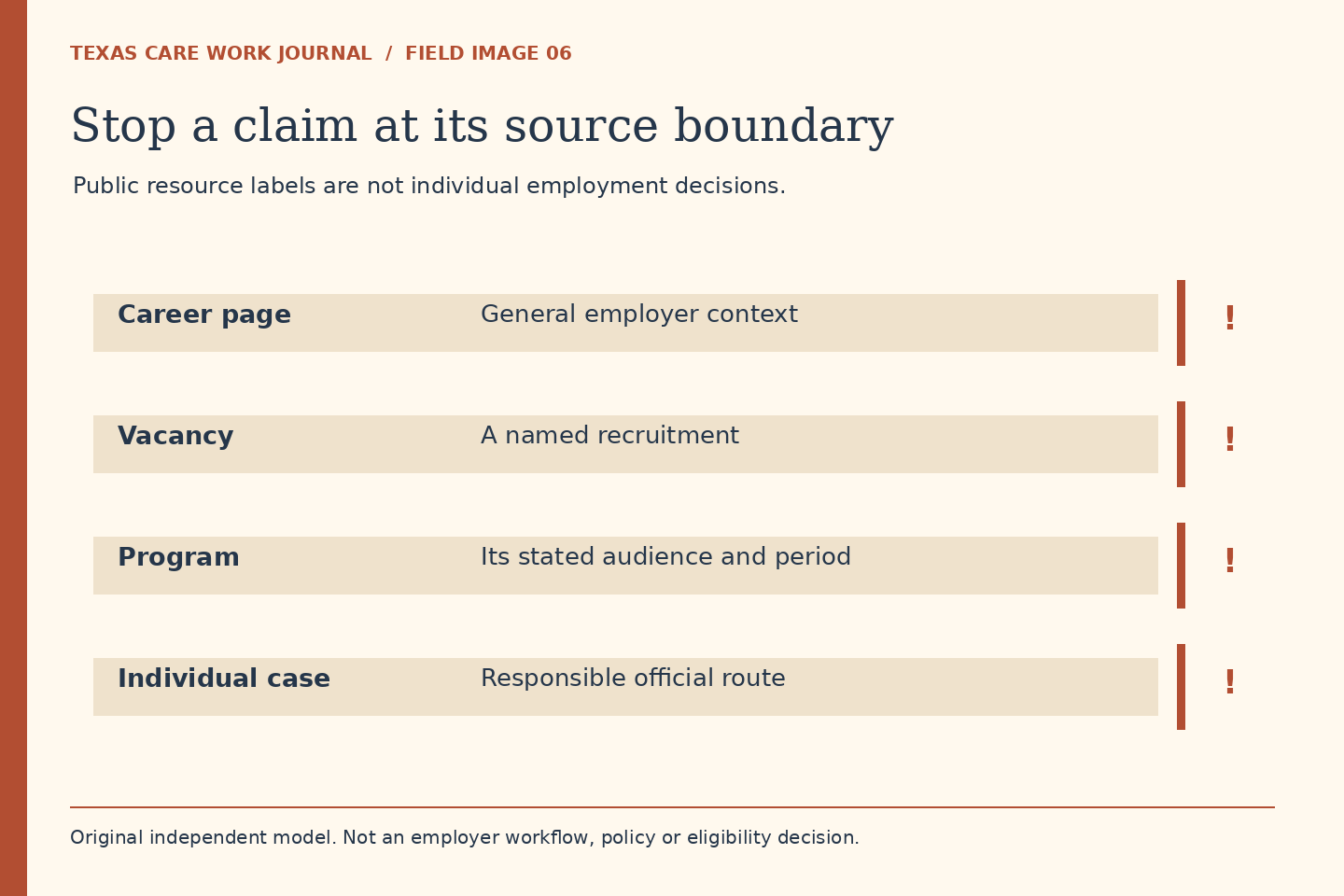
THE COMPLETE ISSUE
Support and allied directions, schedules, commutes, onboarding and feedback. Choose the question that matters for the next step.
18 articles
Work settings
A practical way to compare campuses, offices, affiliates and the everyday conditions behind a North Texas job title.
Read the article : Choose a work setting before you choose a hospital jobCareer evidence
Turn a long posting into a clear application decision without flattening credentials, schedules or location details.
Read the article : Read a healthcare vacancy as a set of requirementsCareer evidence
Make a credible portfolio from your own experience while leaving patient records, internal material and unsupported claims out of it.
Read the article : Build career evidence without borrowing confidential workCareer evidence
Compare the work, education and practical commitments before committing to a new professional direction.
Read the article : Research a support-to-allied-health transition in stagesWork settings
Move beyond a schedule label and establish the pattern you would actually be agreeing to.
Read the article : Ask better questions about shifts and PRN workWork settings
Compare reporting points, shift times and ordinary travel friction before deciding a location is close enough.
Read the article : Test the whole North Texas work journeySupport & allied directions
Prepare to discuss reliability, training and workplace boundaries without pretending to know a hospital’s cleaning procedures.
Read the article : Understand environmental services as skilled, accountable workSupport & allied directions
Show what transfers from service work while leaving dietary decisions and site-specific procedures to authorized staff.
Read the article : Bring food-service experience into a hospital conversationSupport & allied directions
Explain accuracy, traceability and coordination using examples that do not claim authority over clinical supplies.
Read the article : Make inventory experience legible for hospital supply workSupport & allied directions
Ask about technical preparation, equipment-specific learning and responsibility before planning a transition.
Read the article : Explore biomedical equipment work without confusing it with general ITSupport & allied directions
Evaluate the attention, communication and learning involved in a records-oriented career direction.
Read the article : Look closely at health-information work before calling it a desk jobSupport & allied directions
Use the exact occupation and credential requirements to turn an interest in imaging into a focused research plan.
Read the article : Compare imaging career directions by their actual preparationSupport & allied directions
Make education, experience and work setting visible before deciding which laboratory path to investigate.
Read the article : Read laboratory titles without collapsing scientist and technician rolesSupport & allied directions
Use title precision to avoid planning an education route around the wrong kind of work.
Read the article : Why a rehabilitation aide and an assistant are different career decisionsSupport & allied directions
Read the balance of administrative and clinical work without assuming that every clinic uses the role in the same way.
Read the article : Evaluate a medical assistant role as a mix of responsibilitiesLearning & resources
Organize questions, feedback and approved resources without creating a second copy of the workplace’s private information.
Read the article : Build a first-month learning plan that stays inside workplace boundariesLearning & resources
Use a small, observable question to make coaching more useful without inventing performance claims.
Read the article : Turn workplace feedback into a specific learning requestLearning & resources
Use official recruiting and sign-in sources without treating an independent journal as an employee portal.
Read the article : What the public MyTHR pages establish, and what they leave unanswered