In this guide
Make a credible portfolio from your own experience while leaving patient records, internal material and unsupported claims out of it.
Evidence starts with an explanation
A useful career example lets another person understand what you did, how you approached it and why the result mattered. It does not need a screenshot of an internal system or an impressive collection of documents. In healthcare, the desire to demonstrate competence can tempt candidates to preserve material that should stay inside the workplace. A better starting point is an accurate explanation in your own words. Describe your contribution and the kind of work involved without reproducing protected, proprietary or identifying information.
Texas Health's candidate FAQ asks for a resume that covers education, certifications, relevant skills and prior roles. That is a request for a clear account of preparation, not an invitation to export workplace records. The national BLS profile of medical records specialists also underscores the importance of confidentiality in that occupation. This journal's approach is deliberately broader: whether your background is in healthcare, hospitality, retail or administration, choose evidence you are entitled to share and keep the description proportionate to what you can substantiate.
Make an evidence inventory
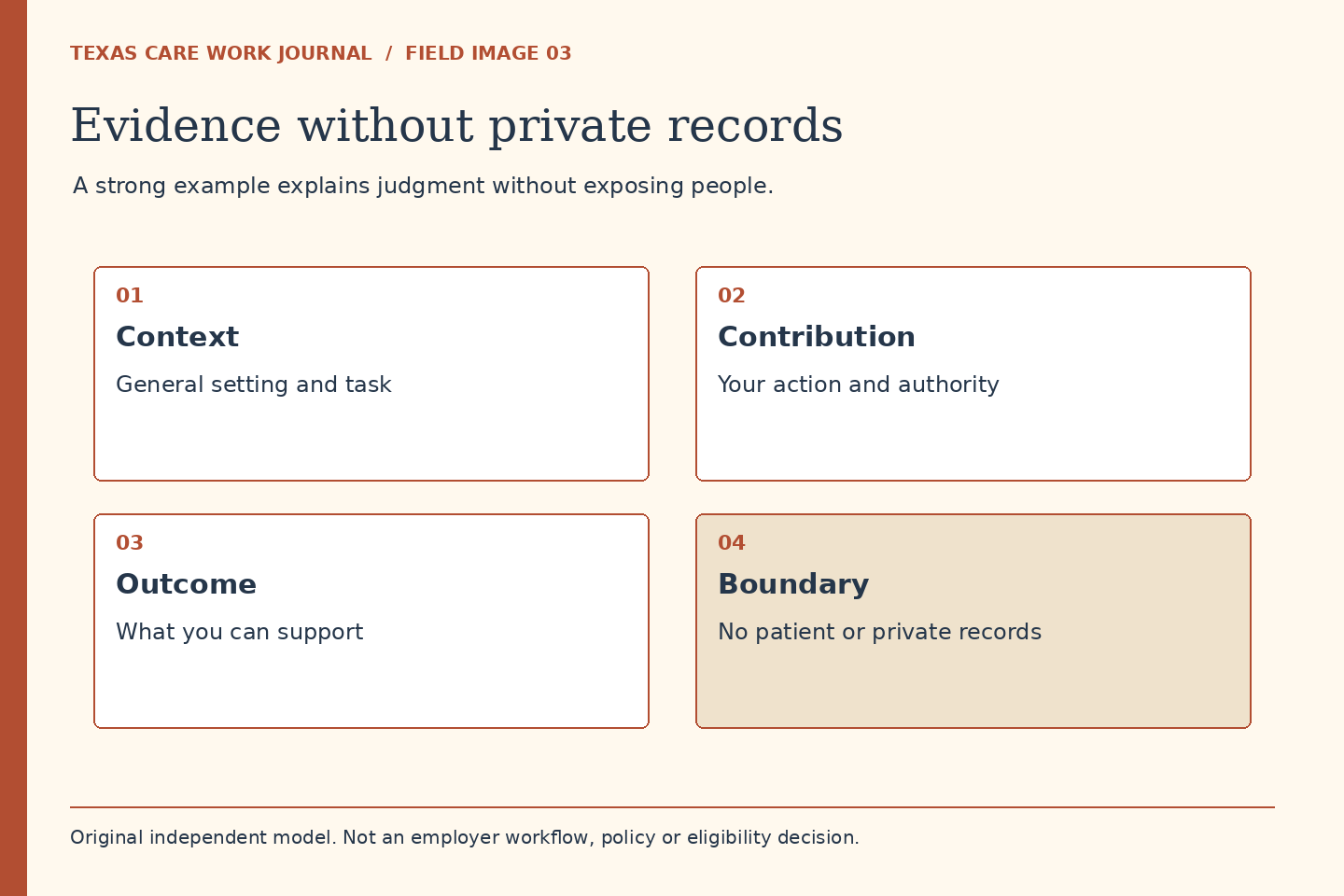
Start with situations rather than adjectives. List occasions when you learned a process, organized competing requests, noticed an inconsistency, followed through on an assignment or helped a colleague understand an approved task. Give each example a working title, such as “reconciled a supply count” or “reorganized a personal study plan.” Then record your actual role. Was the work assigned to you, shared with a team, supervised by someone else or completed independently? That distinction should survive every later rewrite.
For each example, write the situation, your action, the result and the limit of your knowledge. You might know that a revised personal checklist helped you submit work more consistently, but not know whether it changed department-wide performance. Keep the claim at the level you observed. A modest, well-grounded result often gives an interviewer more useful information than a large percentage whose source you cannot explain. Do not manufacture measurements simply because a resume template says every bullet needs a number.
Choose safer forms of demonstration
Original practice materials can show your thinking without exposing workplace content. You could build a fictional appointment grid for a fictional community event, a sample inventory log for ordinary household items or a learning schedule for a course. Label the exercise as self-created and hypothetical. Explain the skill it demonstrates, such as identifying missing information or designing a clear handoff. Do not imitate an employer's private form, reproduce its branding or suggest that your practice document is an approved operational tool.
An existing credential can be named accurately without posting the document publicly. A relevant course can be described without sharing account details or a transcript in an open portfolio. References also deserve restraint: ask permission before giving someone's contact information and use the employer's requested process. Good evidence design is partly about choosing the smallest amount of information that makes the point. A hiring conversation rarely benefits from a folder of unrelated personal documents that creates more review and privacy questions than insight.
Hypothetical example: the careful correction
Imagine an applicant whose previous job involved tracking nonmedical stock at a community shop. The applicant noticed that two item labels were being confused, checked the discrepancy with a supervisor and helped prepare clearer shelf labels. This is a fictional example, not a report about Texas Health. A credible description explains the observation and approved contribution. It does not claim the applicant redesigned the entire supply system or infer an unmeasured reduction in costs. The strength lies in careful verification and collaboration.
The applicant can make a new practice sheet with invented item names to show the logic of the change. It should be clear that the sheet is illustrative, not a copy of the shop's records. In an interview, the applicant can discuss how they asked for clarification before making a change and how they checked that colleagues understood the revised labels. That is transferable evidence of work habits. It does not establish competence to make independent changes to hospital inventory, equipment or clinical processes.
Edit out information you do not need
Review every example for names, dates, locations and unusual details that could identify another person or disclose internal business. Removing a name alone does not necessarily make a story appropriate to share. Rather than attempting your own legal de-identification exercise, choose a different example or describe the general work pattern at a higher level. If you are unsure whether material belongs in a portfolio, ask the appropriate workplace contact before using it. Never move confidential material into a personal tool to help write the example.
Keep official training completion, qualification status and independent practice separate. “Completed an introductory course” should not become “certified” unless the award actually carries that designation. “Observed a process” should not become “performed independently.” These distinctions are especially important when a transition involves regulated or technical work. Precision does not make a candidate sound less capable. It allows the employer to understand where orientation, supervised practice or additional preparation may be needed, while protecting the credibility of the skills already established.
Make the evidence easy to discuss
Choose three strong examples and practice explaining each in about a minute. You should be able to state the challenge, your contribution and what you learned without reading a script or drifting into private details. Prepare a longer version only for follow-up questions. If a detail cannot be discussed appropriately, say that you can explain the general approach without sharing internal information. Then return to your own decisions and learning. A respectful boundary can coexist with a substantive answer.
Finally, attach each example to the requirement it supports rather than using the same story for every question. An accuracy example may not prove leadership, and a leadership example may not demonstrate technical readiness. Use Read a healthcare vacancy as a set of requirements to check that connection and Turn workplace feedback into a specific learning request to strengthen the examples over time. A well-built evidence set stays small, truthful and reusable. Its purpose is to help another person evaluate your preparation, not to recreate the workplace or claim authority you have not earned.
Continue reading: Read a healthcare vacancy as a set of requirements, Turn workplace feedback into a specific learning request, Research a support-to-allied-health transition in stages.