In this guide
A practical way to compare campuses, offices, affiliates and the everyday conditions behind a North Texas job title.
Begin with the working day
A familiar hospital name can make a vacancy feel understandable before you have actually pictured the work. Start somewhere more concrete: where would you report, who would organize your day, and what would make a Tuesday different from a Saturday? Those questions reveal more than the size of a building or the appeal of a department name. A useful comparison should help you decide whether to investigate a role further, not produce a ranking of hospitals from fragments of public information.
Texas Health's public location directory separates settings such as hospitals, primary care, specialist offices, urgent care, rehabilitation and surgery centers. That is evidence of a varied regional footprint, not proof that all locations share one employer or employment arrangement. Its partner directory explicitly describes joint ventures operated by other entities. Keep those distinctions visible as you research. Two places carrying related branding may require separate employment questions, application routes and explanations of who is responsible for the position.
Build a setting card
For each opportunity, make a short setting card using the current official posting. Record the named employer, facility, department, street location, job identifier and date reviewed. Put uncertainty in its own sentence: “Exact reporting entrance not yet confirmed” is more useful than an invented answer. If the listing identifies a broad region rather than one address, ask whether that means travel, rotating locations, a central office or an assignment that will be specified later. Geographic ambiguity can change the entire decision.
Next describe the work in ordinary language without replacing the employer's requirements. “Inventory coordination in a hospital setting” is a working summary; it is not an official title. Capture who the role appears to serve, whether work is mostly at one station or across a campus, and what information is handed to other teams. This helps separate interest in an organization from interest in the actual tasks. You may admire a hospital's mission and still prefer the rhythm of an office-based role elsewhere.
Compare the sources of variation
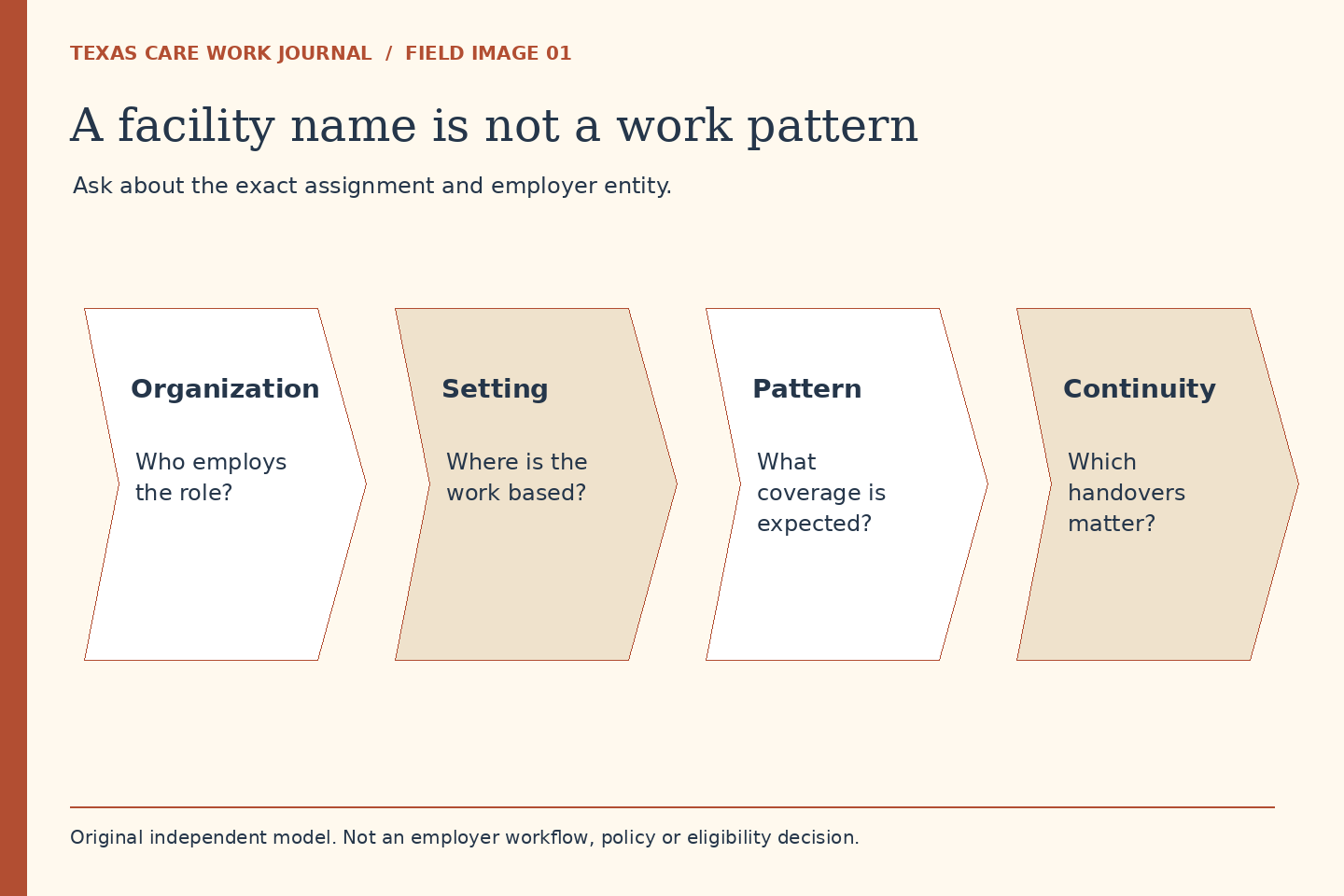
Look for the dimensions that are likely to affect your daily routine: scheduled hours, weekend expectations, physical location, public interaction, independent work and the availability of a supervisor during your shift. Do not presume that an outpatient address means business hours, that an administrative role means remote work, or that a hospital role means bedside care. Treat each impression as a question until the posting or hiring team answers it. Public service hours also need not match employee reporting hours.
Your own priorities should be specific enough to test. “I need a predictable schedule” could mean knowing the next month's shifts early, working the same days each week, or avoiding last-minute changes. Those are different conditions. “I prefer variety” might mean different tasks within one site, rather than driving between sites. Write down the actual condition that matters and ask about it directly. This is much more informative than asking whether a team offers flexibility and receiving a broad, encouraging answer.
Hypothetical comparison: two similar titles
Imagine a candidate comparing two fictional administrative vacancies. One is described as a fixed-site role at a hospital campus. The other supports several outpatient offices. Neither example represents a current Texas Health opening. The candidate likes the second title because it sounds familiar, but the location details are vague. Rather than scoring it lower automatically, the candidate asks how often reporting locations change, how much notice is typical, and where training takes place. A clear answer could make the role either more suitable or less suitable.
The campus role has a different uncertainty. Its listed shift ends at a time that appears compatible with the candidate's commitments, but the campus is large and the reporting point is unknown. The candidate asks about staff parking and the usual route to the department instead of using visitor instructions as employee policy. Both investigations concern fit, yet they require different evidence. A single measure such as distance from home would miss those differences and could favor the wrong opportunity.
Separate the organization from the employment offer
Texas Health's career category pages state that the displayed employment opportunities reflect wholly owned Texas Health Resources entities. Read that boundary alongside the broader facility directory rather than assuming the two lists cover identical organizations. When a partner's site becomes the relevant source, start a separate record for that employer. Shared branding is not enough to establish that onboarding, internal mobility, benefits or scheduling arrangements transfer between entities. Ask the named hiring organization to clarify anything that affects your decision.
The same restraint applies to promotional descriptions of culture. They can suggest interview questions, but they cannot tell you exactly how one manager assigns work or how a particular team welcomes new colleagues. Convert an attractive claim into something observable: how is a new employee introduced to partner departments, where are questions collected during training, and when is feedback discussed? You are looking for concrete practices, not demanding that a recruiter guarantee an experience that no one can fully predict.
Finish with a deliberate next step
End the comparison with one action for each card: investigate, apply, hold for clarification or set aside. Include the reason in a sentence you will still understand a week later. “Hold until reporting locations are confirmed” preserves an open possibility. “Set aside because the stated overnight schedule conflicts with an immovable commitment” records a genuine mismatch. Neither judgment says anything about the quality of the employer. It simply respects the conditions under which you can do good work.
Keep the cards short enough to update when a posting changes. Their purpose is to prevent a major decision from being driven by a familiar name or an incomplete mental picture. Once a setting seems workable, read the position more closely with Read a healthcare vacancy as a set of requirements. If the commute remains the deciding issue, use Test the whole North Texas work journey to test the whole journey. A well-chosen setting is one whose important requirements you understand, including the parts that still need an answer.
Use the Role & Setting Lens for a bounded practice or research step.
Continue reading: Read a healthcare vacancy as a set of requirements, Test the whole North Texas work journey, Research a support-to-allied-health transition in stages.