In this guide
Compare the work, education and practical commitments before committing to a new professional direction.
A transition is several decisions
Moving toward a new healthcare occupation is rarely one decision called “go back to school.” It can involve choosing a kind of work, understanding a credential, comparing education programs, arranging time and then finding an appropriate application opportunity. Treat those as separate questions. A current support role may offer useful knowledge of workplace coordination, yet that experience does not automatically replace the education or authorization another occupation requires. Begin by identifying what you want to do differently, not simply what title you hope to hold.
Texas Health's allied health page names a range of technical areas, including imaging, respiratory therapy and sterile processing. That variety matters because there is no single allied-health qualification that covers them all. National occupational sources likewise distinguish roles that sound similar. BLS describes physical therapist assistants and aides separately, with different typical preparation. These sources can orient your research, but they do not decide whether your specific education meets a Texas requirement or whether an employer will accept it for a particular vacancy.
Test your interest in the work itself
Write a plain-language description of the work that attracts you. Perhaps you enjoy careful technical problem-solving, sustained work with information, structured service tasks or coordination across departments. Then ask what part of the proposed occupation actually contains that activity. A role's most visible moments may not represent most of its day. Read the duties, work setting and training sections of a reputable occupational profile, then compare them with current employer descriptions. Record disagreements or gaps instead of smoothing them over.
Seek legitimate ways to learn more without assuming access to a workplace. Public career events, program information sessions and an informational conversation arranged with permission can help. If observation is offered, follow the organization's requirements; do not treat employment in one department as permission to visit another for informal shadowing. Prepare questions about learning, teamwork and responsibilities. Avoid asking staff to reveal patient stories, internal staffing details or confidential performance information merely to make your research feel more vivid.
Build a qualification chain
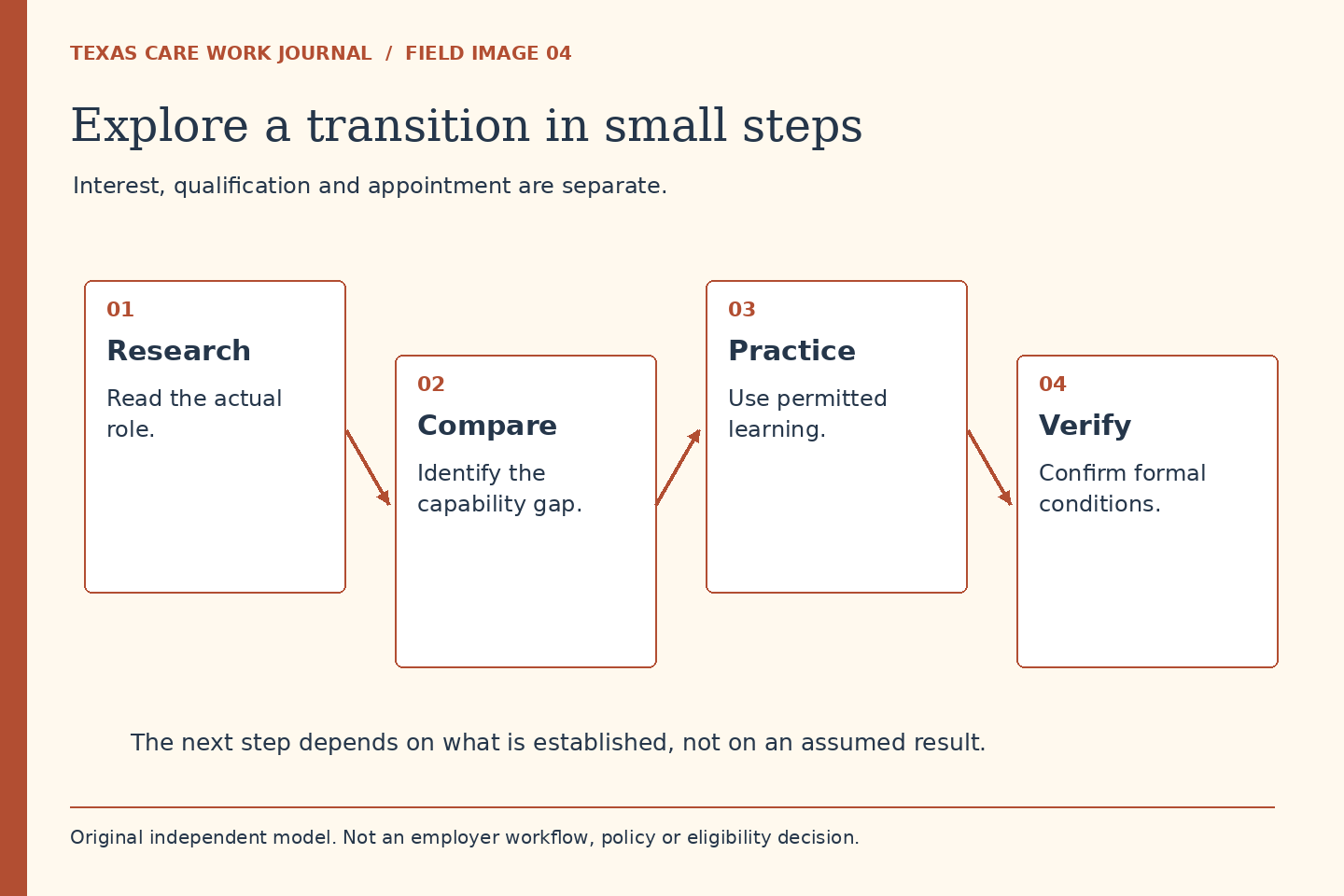
For the occupation you are considering, identify the employer requirement, the relevant credentialing or licensing authority, and the education program's stated outcome. Follow those three links carefully. A course provider's marketing language does not settle what an employer requires. An occupational profile's statement about typical education does not determine your eligibility. If the sources use different titles or abbreviations, ask each organization a specific question about the difference. Keep written answers with the date, especially when a program's promise is central to your decision.
Map the sequence rather than assuming everything can happen simultaneously. A program may have prerequisites, application windows, supervised placements or separate assessment steps. Confirm those directly with the provider and responsible authority. Ask what happens if a placement is delayed or a requirement changes. This is preparation for a decision, not legal, licensing or financial advice. Do not enroll because a generic article appears to connect the boxes. Your next step should rest on current, program-specific information you have actually verified.
Look at the learning arrangement
Investigate how you would learn as carefully as what you would learn. Ask about class times, attendance expectations, practical components, location changes and the tools required for study. If you plan to remain employed, compare the real schedule rather than an ideal week with no disruptions. Identify which commitments are flexible and which are fixed. A viable transition plan should have space for ordinary travel, preparation and administrative work, not just the hours printed in a course timetable.
Employer-supported programs deserve the same scrutiny. Texas Health publishes information about residency and apprenticeship routes, but program terms and participation requirements are specific. The graduate nurse residency FAQ, for example, describes a particular recruiting process rather than a general promise of internal progression. Do not assume that a colleague's earlier arrangement is still available or applies to another entity. Ask the official program contact about the current cohort, role and requirements, and distinguish receiving information from receiving a place or an employment offer.
Hypothetical example: from repair interest to research
Imagine a support employee who enjoys troubleshooting ordinary office equipment and becomes interested in biomedical equipment work. This is a hypothetical career exploration. BLS describes medical equipment repair as a field with technical preparation and equipment-specific learning. The employee first compares the actual work with their interest, then reads several current role descriptions. They discover that “good with technology” is too broad a statement to plan from. They need to understand which training and experience the target roles actually request.
Instead of buying the first course advertised online, the employee creates a question list for relevant programs and employers. What qualification does the course lead to? What practical experience is included? Which prerequisites remain? What part of the training would occur during normal working hours? The employee also prepares truthful examples of careful troubleshooting from their own background, while acknowledging that this does not authorize medical equipment work. The immediate outcome is a better research decision, not a claim that the transition is already secured.
Set a useful stopping point
A first research phase can end when you can explain the target occupation, its verified preparation requirements, two realistic learning options and the most important unresolved condition. You do not need to investigate every healthcare career. Choose a date to review what you have learned and decide whether to deepen the research, change direction or pause. A pause can be a sound outcome if the required arrangement is not workable now. It preserves your time without turning an uncertain option into a permanent rejection.
Use Build career evidence without borrowing confidential work to describe what you already bring, and the role-specific articles in this journal to sharpen questions about records, imaging, laboratory, rehabilitation or biomedical work. Keep ambition and verification together. A good transition plan recognizes the value of your present experience while giving the new occupation the preparation it deserves. That balance produces a more credible application and a more informed personal decision than either assuming the move is easy or assuming every unfamiliar requirement makes it impossible.
Continue reading: Build career evidence without borrowing confidential work, Ask better questions about shifts and PRN work, Understand environmental services as skilled, accountable work.