In this guide
Move beyond a schedule label and establish the pattern you would actually be agreeing to.
A label is the beginning
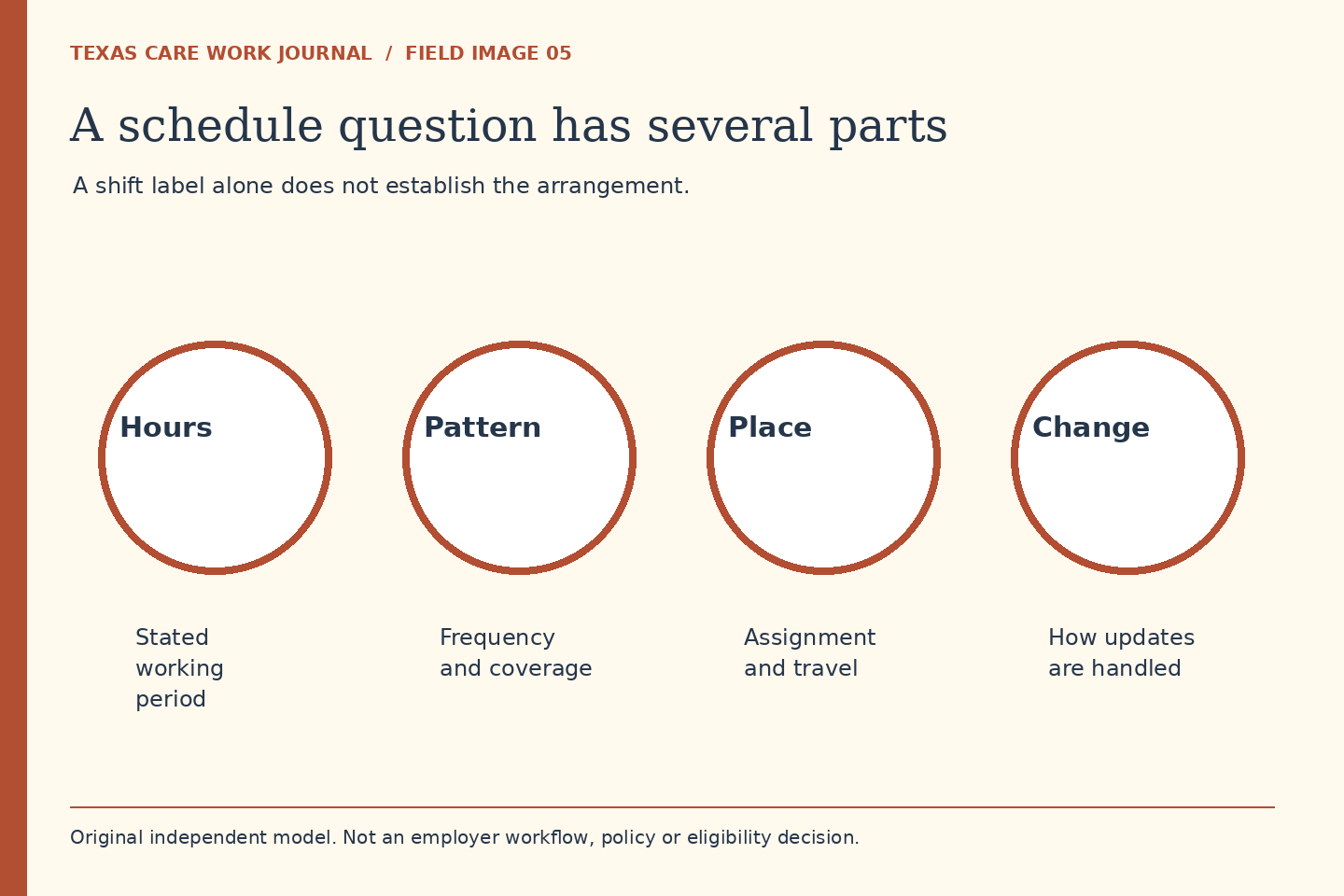
A schedule label can hide several separate questions. How long is a shift? Which days can it fall on? How far ahead is the pattern known? What availability must you provide? Texas Health's public candidate FAQ describes full-time, part-time and PRN work, along with several shift types, and directs candidates to individual postings for details. That does not establish the arrangement for a particular department. Use the label to start a conversation rather than treating it as a complete description of your week.
First write down what the posting actually says. Keep employment type, shift, hours and location in separate lines. If “as needed” appears, do not silently translate it into either guaranteed flexibility or guaranteed work. If a posting names days but does not explain weekends, record the unanswered question. A clear note protects you from remembering an assumption as though it were something the recruiter confirmed.
Ask about the pattern
Replace “Is the schedule flexible?” with a question that describes the issue. You might ask how availability is submitted, how assignments are communicated, or whether the regular pattern differs during training. Ask which expectations are fixed and which can vary. The hiring team may not know every future assignment, but it should be possible to discuss the role's stated requirements and the process used to communicate them.
Your own availability should be equally precise. If you can work some evenings but have an immovable commitment on one weekday, explain the relevant scheduling limit through the appropriate recruiting conversation. You do not need to disclose unrelated personal details. Avoid promising open availability while hoping to renegotiate an essential condition later. A truthful discussion now makes it easier for both sides to assess whether the arrangement is workable.
Hypothetical example: a workable week
Imagine a candidate considering a fictional PRN support vacancy. The candidate initially assumes it would fit neatly around another job. After reviewing the description, they realize that minimum availability, orientation dates and weekend expectations are not clear. They prepare three questions about those subjects. The useful outcome is not necessarily acceptance or rejection; it is discovering what commitment is actually being considered before rearranging other work.
The candidate then sketches a sample week using the confirmed requirements. Travel, preparation and existing commitments belong on that sketch as well as paid working hours. If the arrangement only works when every journey is unusually short and no other obligation changes, the candidate has learned something important. This is a practical planning exercise, not a prediction of the employer's future scheduling decisions.
Keep the answer attached to the role
Record who answered, when and which job identifier the answer concerned. If an interview produces new information, compare it with the current posting and seek clarification on any material difference. A statement about one department should not become your assumption about another. Likewise, a friend's experience can suggest a question but cannot establish the conditions of your offer.
Before deciding, summarize the known pattern in your own words and ask whether you have understood it correctly. Use Test the whole North Texas work journey to add the journey and Choose a work setting before you choose a hospital job to compare the working environment. The aim is a schedule you can describe accurately, with remaining uncertainty acknowledged, rather than a reassuring label that leaves the most important practical details unresolved.
Continue reading: Test the whole North Texas work journey, Choose a work setting before you choose a hospital job, Bring food-service experience into a hospital conversation.