In this guide
Turn a long posting into a clear application decision without flattening credentials, schedules or location details.
Read for decisions, not keywords
A healthcare vacancy can contain mission statements, qualifications, responsibilities, scheduling details and application instructions in one long page. Reading from top to bottom is necessary, but it is not always enough. The useful question is what each part requires you to decide or verify. Separate facts about the employer from facts about this particular job. Then separate those from your own assumptions. That small discipline prevents a familiar title from obscuring a condition that matters much more than the title itself.
Texas Health's public candidate FAQ directs applicants to job postings for position-specific hours and work location. Its allied health page groups several different technical occupations under one career area. Together those sources illustrate why category browsing is only the start. A category can help you discover a direction; a specific, current posting supplies the requirements you must actually consider. This article offers a reading method, not a statement that any named occupation is hiring today or that a reader qualifies for it.
Preserve the posting's identity
Record the official URL, job identifier, exact title, location and the date you read it. If you save a personal copy, follow the site's normal options and keep it for reference rather than circulating it as a live vacancy. Search results can retain wording after a position changes. An identifier makes later questions much easier to answer than “the clinic job I saw last week.” Before applying, return to the employer's current page and compare any details that influenced your decision.
Read the employment type and schedule together. Full-time, part-time and PRN describe different aspects of an arrangement from day, evening or rotating shifts. Neither group necessarily tells you the precise weekly pattern. Note what is explicitly stated, then write a focused question for what remains unknown. A posting can be accurate without answering every practical question you have. The goal is to recognize the gap early rather than fill it with an expectation drawn from your previous employer.
Separate required, preferred and unclear
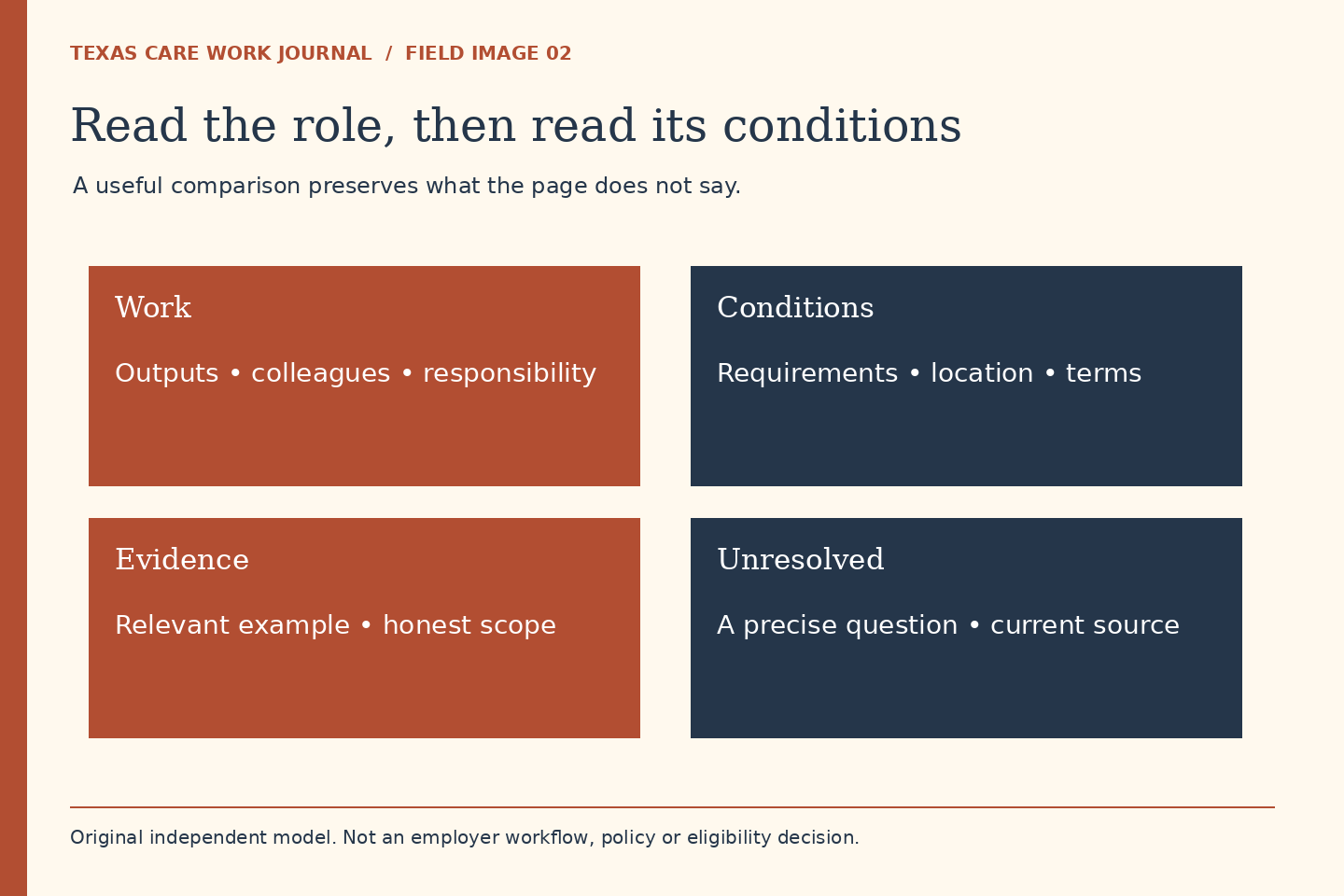
Use three headings in your private notes: stated requirements, stated preferences and questions. Copy credential names accurately rather than substituting a shorter label that could refer to something else. Note any timing language, such as a qualification needed at application, by the start date or within a stated period. If timing is absent, leave it unresolved. This reading process does not determine eligibility; the employer and relevant credentialing authority must answer questions about whether your particular education or status meets a requirement.
Preferences deserve attention without being promoted into hard exclusions. Conversely, an enthusiastic description of training should not be used to erase a stated requirement. Write a truthful match beside each item: credential held, experience available to describe, requirement not met, or clarification needed. Avoid calculating a simplistic percentage match. Missing one essential credential can matter more than matching ten broad attributes. Equally, lacking a preferred software package may be a different issue from lacking the required professional authorization.
Translate duties into evidence
For each major responsibility, ask what kind of past example would help another person understand your preparation. A duty involving coordination may connect to a time you managed several deadlines. An accuracy requirement may connect to a documented checking process. Use examples from the setting in which they actually occurred. Retail stock work can demonstrate careful inventory habits, but it should remain retail stock work in your description. Renaming it as hospital supply-chain experience would weaken the accuracy of the application.
Do not turn every line into a separate resume bullet. Look for two or three central work patterns and choose evidence that genuinely fits them. Explain your contribution, how you worked with others and what you can substantiate about the result. If an achievement depended on a team, say so. If a number is an estimate, either label it appropriately or use a precise qualitative description. Clear evidence is more useful than impressive wording that becomes difficult to explain in an interview.
Hypothetical close reading
Consider a fictional posting for a support position at one North Texas location. Its title sounds entry level, but the qualifications specify prior experience and a named certification. The candidate has related customer-service experience but does not hold that credential. The productive next step is a narrowly framed question about the stated requirement, if clarification is genuinely needed. It is not to assume that enthusiasm, a different certificate or employment elsewhere in the system makes the requirement optional.
Now imagine that the same fictional posting calls a second skill preferred. The candidate has a credible example of learning an unfamiliar system but no direct experience with the named one. That can become a truthful application statement about learning and accuracy, while preserving the distinction between transferable experience and direct expertise. The method protects both sides: the candidate avoids overstating preparation, and the hiring team can evaluate the actual background rather than decoding vague claims such as “fully proficient in all systems.”
Create a compact decision record
Finish with three sentences. The first says why the work interests you. The second identifies the strongest relevant evidence you can provide. The third states the condition or question that could change your decision. If you cannot write the first sentence without repeating the employer's mission language, revisit the duties. If the second is vague, develop a better example. If the third contains five unresolved essentials, gather answers before investing hours in tailoring an application.
A good reading ends with a bounded choice rather than endless research. Apply when the available information supports a truthful application and the arrangement appears workable; seek clarification when a material detail is missing; or choose a different direction when a stated condition conflicts with your needs. Continue with Build career evidence without borrowing confidential work to assemble nonconfidential examples, or Ask better questions about shifts and PRN work to clarify schedule language. Keep returning to the current official posting, because a careful reading is only as reliable as the document it describes.
Continue reading: Build career evidence without borrowing confidential work, Ask better questions about shifts and PRN work.